Search This Blog

Showing posts with label war memorial. Show all posts

Tuesday, 6 May 2014

QUEEN ELIZABETH PARK, LITHGOW NSW AUSTRALIA

QUEEN ELIZABETH PARK, LITHGOW NSW AUSTRALIA

So that we all know what we are talking about, Lithgow Park and Queen Elizabeth Park are one and the same place, the name change being made to coincide with the Queen’s visit to Lithgow on Friday 12th February 1954.
Lithgow isn’t short of playing fields, but it is rather light on parks and gardens. This is changing as the city grows in the 21st century, but the older parts of town are still deficient. This is a direct result of the city’s industrial past and the acute housing shortages caused by two world wars, when the coal mines and the Small Arms Factory were vital to Australia’s survival. Simply housing an extra 10 000 people took priority and the rapid decline in population after these conflicts were over caused another set of problems.
In the early days, there were practically no public spaces near the centre of town. What are today vacant areas used as sporting fields were often industrial sites then. As the population grew, so did the agitation for public parkland.
We read in the “Evening News” from Sydney for 27th November 1894, on page 4, “that Lithgow, which was one of the most important towns in the western district, was without a park of any description, and as far as the deputation knew, there were no Crown lands which were available for the purpose, and the Minister was asked to resume a suitable block for the purpose. At present there was no place where they could hold sports, nor where children could play, without trespassing on private land. In reply the Minister for Lands said there was no money available for the purchase of lands for parks, but should any sum be placed on the estimates for the purpose, the claims of Lithgow would be carefully considered.”
By February 1897 there had been little change and it was not until the following year that we read in the “Sydney Morning Herald”, for Saturday 19th November 1898, on page 9 that “The Hon. J Cook is in receipt of a communication from the Lands Department notifying that the Minister for Lands has approved of 14 acres of land being purchased as a public reserve and park for Lithgow”. Joseph Cook, later Sir Joseph, was a former Lithgow coal miner who had become the local member in the NSW parliament. Later still, he became Prime Minister of Australia. The new boardwalk at Hassan’s Walls (2014) has been named to honour him.
Finding and purchasing the site was one thing, but developing it was another. More than 10 years later, money was still being sought for park development. Mr Charles Hoskins, one of the owners of the steel works at Lithgow, offered a sum which had to be matched by other donations. This was proving hard to come by.
1920's - note the smoky background, now a thing of the past
After World War 1, the decision was made to place the city’s War Memorial in Lithgow Park, which has meant that the park from then on became the centre of public ceremonies and festivities, a tradition which continues today. Probably the greatest of these was the visit of Queen Elizabeth and the Duke of Edinburgh on February 12th, 1954. There is a good report of the event in the “Herald” of Saturday 13th February, on page 6. It was to honour Her Majesty that the park’s name was changed from that day on. It sounds like a great time was had by all and the memories of the day remain strong in the district, 60 years on.
Uncle Christy Hayward in Lithgow Park 1953

Saturday, 21 September 2013

MT VICTORIA PARK BLUE MOUNTAINS NEW SOUTH WALES AUSTRALIA

MT VICTORIA PARK 

BLUE MOUNTAINS NEW SOUTH WALES AUSTRALIA

Mt Victoria is on the western edge of the Blue Mountains. It came into existence mainly because of the coming of the railway in 1868, when it became the terminus while the Great Zig Zag was being constructed near Lithgow. This allowed the railway to descend from the mountains to the more fertile regions beyond. The development of Jenolan Caves as a tourist resort brought crowds to the town as it became the base for those coming from Sydney by train before transferring to road transport for the rest of the journey. Right from the construction of the first road across the Blue Mountains in 1815 until now, most road traffic has left the mountains at Mt Victoria.

Despite all of this development, the town’s population has not exceeded 1,000 and today it is a quiet mountain community which gives the impression that it plans to stay that way.

Mt Victoria Park is one of the most accessible spots along the Great Western Highway for travellers to stop for a break and they share it with the locals who clearly have a great deal of affection for the place.

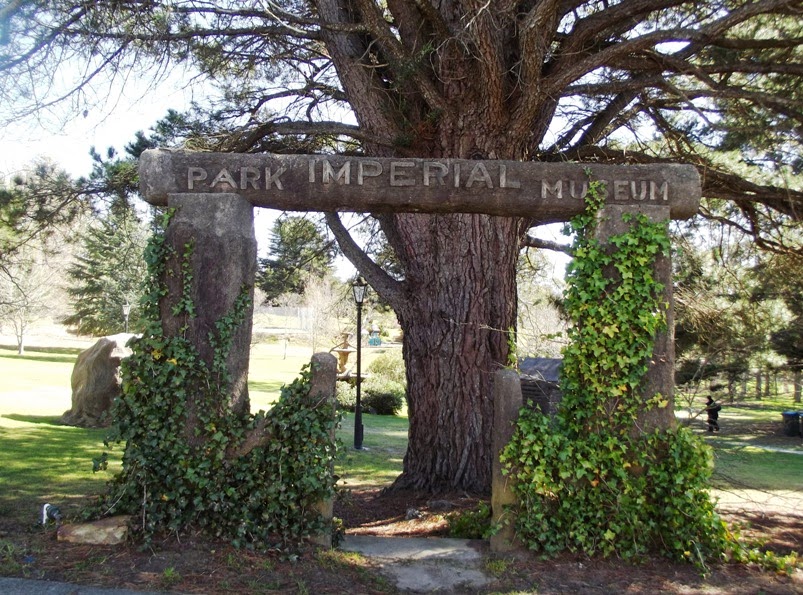
Two of its entrances have signs over them; that from the Highway calls the place “Memorial Park” while the Station St entrance rather grandly states “Imperial Park Museum”. This reflects the fact that the two sections of the park had different origins. The First World War memorial is a prominent feature of one, the original community owned part, while the other was formerly the property of the Imperial Hotel (across the road). It contains a number of bizarre structures which look like they might have once have held exhibits of some sort, perhaps animal dioramas, though I haven’t been able to confirm this. See the photos at the end of this blog. The board appeared in the park early in 2016.
The two were merged as “Mt Victoria Park” when the Blue Mountains City Council bought the lower section from the Hotel owners in 1979.

The stimulus for the purchase of the land now forming the core of the park seems to have been the centenary of the crossing of the Blue Mountains in 1913. While nearby Mt York was the focal point for the unveiling of memorials (just as it has been in 2013 for the bicentenary), a site was needed which was more suitable for festivities, which was more accessible and could accommodate a crowd. You can read about all this in the newspapers of the day. The photograph (source unknown) show the crowds making their way to the park for the celebrations in May 1913.

The park became the venue for large picnic groups soon after this, since it is handy to the railway station. Railway picnics brought thousands and you could say “a good time was had by all”.

The construction of the War Memorial must have been a great event too, and the newspaper reports reveal the tremendous emotional energy behind the occasion. It seems strange to us that it should have been unveiled 5 months before the war concluded. Reading between the lines, it seems that feelings were running high in the community, as they were in many other small places where some men were perceived as not “doing their duty”.

Some recommended reading (source www.trove.nla.gov.au): The 1913 Centenary celebrations (Clarence and Richmond Examiner (Grafton, NSW: 1889 - 1915), Thursday 29 May 1913, page 5);  
The 1914 Railways Picnic (Nepean Times (Penrith, NSW): 1882 - 1962), Saturday 12 September 1914, page 6); 
The March of the “Cooees” (The Sydney Morning Herald (NSW: 1842 - 1954), Friday 5 November 1915, page 8); 
The opening of the War Memorial (The Blue Mountain Echo (NSW: 1909 - 1928), Friday 7 June 1918, page 3).

View my Blue Mountains videos here . I have three other playlists - gem hunting/mining, Glen Innes and New Zealand. The video about  Mt Victoria Park is here.

This board appeared early in 2016
These are the three photographs on the information board.